Wall Painting in a Child's Room — Choosing a Subject That Won't Get Old

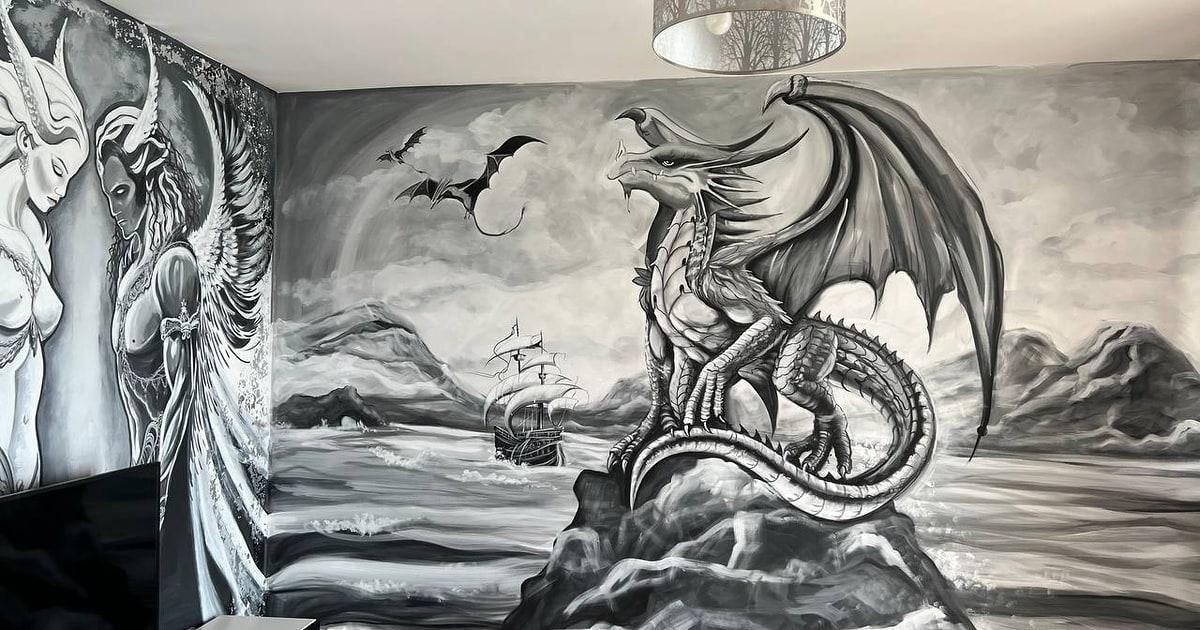
Table of contents
A child's room is the only room in the house that dates not from wear but from its occupant growing up. What delights a four-year-old embarrasses a ten-year-old. So the central question when painting a child's room isn't "what shall we paint" but "what will still work in five years."
Below I explain how to choose a subject with room to grow, which materials are safe in a child's room, and what to do when the child outgrows the fairy tale.
The Main Mistake — Specific Characters
The most common request: paint a favourite cartoon character. Understandable — the child is thrilled and the parents see that joy.
The problem is twofold.
First — a shelf life. The favourite character changes every six to twelve months. In two years the child will be embarrassed by what was once a source of pride. In four, they'll ask for it to be painted over.
Second — copyright. Cartoon characters are protected. In a private home this rarely becomes an issue, but for a child's area in a clinic, a children's centre or a café, the risk is real.
What works instead: a subject from the same world, but without the specific character. Not that particular hero, but space with planets and a ship. Not that specific princess, but a castle on a cliff in the mist. The child fills in the story themselves, and the wall isn't tied to a franchise.
Subjects That Grow With the Child
Nature and landscape. Forest, mountains, sea, a field of tall grass. Works at any age: at three it's "where the animals live," at fifteen it's simply a beautiful view. The longest-lasting option.
Sky and space. Clouds on the ceiling, a starry sky, planets. Universal, calm, not tied to an age. Works well above the bed.
Maps and travel. A stylised world map, routes, ships. Grows with the child: first a picture, later a genuine interest in geography.
Architecture and cities. Rooftops, lanes, bridges. Matures with the room — by the teenage years it's almost a poster.
Botanical ornament. Large leaves, branches, flowers. Calm, decorative, not nursery-ish. Often chosen for girls' rooms — and it carries through to the end of school.
Abstraction and geometry. Mountains made of triangles, colour blocks, gradients. Contemporary, doesn't date, combines easily with any furniture.
Accounting for Age
0–3 years. The room is more for the parents than the child — an infant won't appreciate it. Calm tones, soft forms, nothing harsh. Don't overload it: too much detail tires the eye and gets in the way of falling asleep.
3–7 years. Peak interest in stories. Here a fairy tale or an adventure both work — but on the principle of "a world, not a character." The child now takes part in the choice, and that matters to them.
7–12 years. Interests emerge — space, dinosaurs, sport, music. The subject can get more specific, but better through atmosphere than through logos and branding.
12+. A teenager doesn't need a painting "for children" but a space they consider their own. Here graphics, abstraction, urban motifs and monochrome work. Often the teenager knows what they want — it's worth listening.
Materials — What's Safe
A child's room calls for attention to what goes on the wall.
Water-based paints. Acrylic without solvents, odourless once dry. Look for labelling on low volatile organic compound (VOC) content. European manufacturers state it clearly.
Time before moving back in. Acrylic dries within hours, but full curing takes several days. I recommend not using the room for 3–5 days after work finishes and airing it well — not because it's dangerous, but because it's more comfortable that way.
Protective coating. Particularly necessary in a child's room: walls get dirty, get rubbed, and are sometimes drawn on. A matt varnish over the painting lets the surface be wiped with a damp cloth.
What I don't use in a child's room: aerosols, solvent-based enamels, metallic pigments, anything with a strong smell.
Practical Points
Placement. Don't paint the wall behind the headboard if the subject is active — the child doesn't see it, but everyone else does. It makes more sense opposite the bed, or on a wall visible from the play area.
Furniture. The painting has to take into account what will stand against the wall. A composition half-hidden by a wardrobe is money wasted. Send a furniture plan, or tell me what goes where.
Sockets and switches. These are worked into the composition — becoming part of the subject rather than an obstacle. Sometimes I include them deliberately: a switch as a window in a little house, a socket in a tree trunk.
Light. A child's room often has a night light or a string of lights. Dark, saturated colours look gloomy in dim light. For the wall next to the bed I choose a lighter palette.
Involving the child. If the child is over four — show them the sketch. Not for approval, but so they feel the room is theirs. Sometimes children suggest details an adult wouldn't have thought of.
Timelines and Prices
Timelines. A child's room is usually 10–18 m² — that's 5–8 days of work for a moderate subject, plus the sketch beforehand and varnish afterwards. Around two weeks in calendar terms.
Price. €50–140 per m² depending on the level of detail. A fairy-tale landscape with cottages and figures sits at the upper end, stylised mountains or clouds at the lower. More on pricing in the article about the cost of wall painting per square metre.
Plan it into the works. Painting is done after the wall finish but before the furniture goes in. If the room is already lived in — we work with covering, which is fine, just a little slower.
What to Do When the Child Grows Up
Three options, all workable.
Paint over it. Ordinary paint in 2–3 coats, no relief to remove. A day's work for a decorator.
Rework it. Often cheaper than a new painting from scratch: the base is there, only the subject or part of it changes. A fairy-tale forest becomes a graphic mountain landscape — half the work is retained.
Leave it. If the subject was chosen with room to grow (nature, sky, abstraction), it survives the transition without trouble. In ten years it's simply a beautiful wall rather than "a child's mural."
That's exactly why I always suggest thinking ahead — the third option is cheaper than the first two.
FAQ — Questions from Parents
My child wants a specific character. Is it completely out of the question?
No, if you accept that in two or three years you'll want to change it. A compromise: the character in a small area (not the whole wall) that's easy to rework, with a neutral main subject.
Is the paint safe if the child touches or licks it?
Water-based acrylic is inert once dry. But in a child's room I always varnish over it — that both protects the wall and adds a further barrier.
Can you paint furniture or a door?
Yes — a wardrobe, a door, a headboard are common requests. Bear in mind: furniture is often replaced sooner than the wall, so painting on it has a shorter life.
How long before we can use the room again?
3–5 days with airing. There'll be no smell after a day, but full curing of paint and varnish takes several days.
Can you paint the ceiling?
Yes, and in a child's room it works particularly well — the child looks at the ceiling every evening before sleep. A starry sky, clouds, tree canopies. Technically harder (working overhead), so around 20% more per metre.
How to Start
Send a photo of the room, the wall dimensions, the child's age and a few words about their interests. Tell me what furniture will stand where. I'll propose 2–3 subject options, designed so the room lasts ten years rather than two.
If the child is old enough — ask what they want. It's the best source of ideas, and taking part in the decision makes the room genuinely theirs.
Planning a painting for a child's room? Write to me — send a photo of the room and tell me about the child. I'll suggest a subject that won't get old. The consultation is free.