Combining People from Different Photos into One Portrait
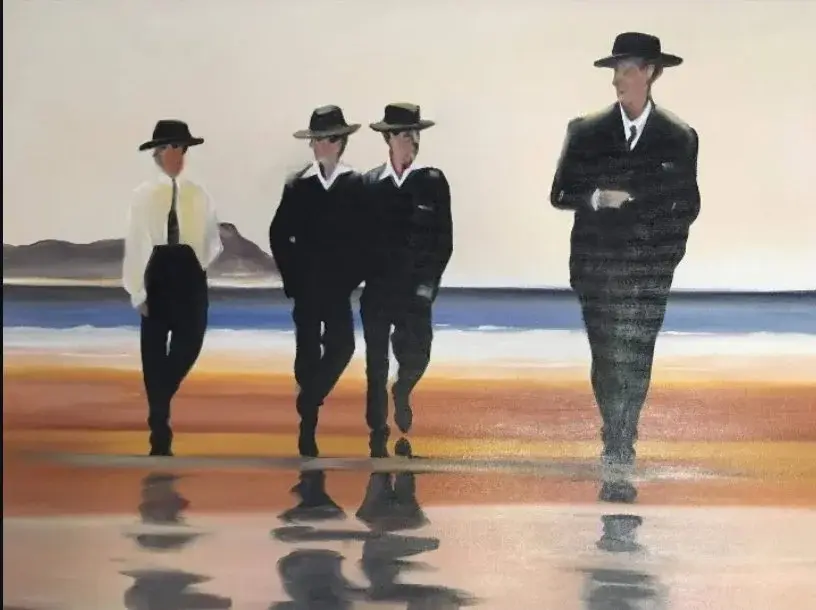
Table of contents
Sometimes a photo of everyone together simply doesn't exist. The family lives in different countries and hasn't gathered in years. The children have grown up, and the pictures where they're all together are from a completely different age. Or there are good individual portraits of each person, but not a single successful group shot.
Painting solves this in a way photography cannot. I take faces from different images and bring them into one composition — with unified light, unified space, natural interaction. This is not a collage in an editor, but a full artistic process.
Why Simply "Merging" Photos Isn't Enough
When I receive four different photographs — taken in different years, in different places, with different cameras — I don't just copy faces. I have to create the impression that they all exist in the same space, the same light, the same moment in time.
Problems that must be solved:
Different image quality. One photo is sharp, from a modern smartphone. Another is an old amateur print with fewer details. A third is a scan from film. Each contains a different amount of information about the face.
Different stages of life. If one person in the image is noticeably younger and another is from today, their features sit in different proportions. I have to reconcile this so the people look like contemporaries of one another, not characters from separate eras.
Different lighting. Natural window light in one photo, studio light in another, a room lamp in a third. If I simply copied the shadows from each image, the portrait would look like a collage rather than a whole.
Different head positions. One person looks straight ahead, another at an angle, a third slightly turned away. Not only the faces but their placement in space must be reconciled.
How I Work with Several Photographs
Step 1: detailed analysis of the source material
When I receive your photos, I carry out a thorough analysis. I look not only for facial features, but for character — how a person smiles, how their gaze looks, how the hair falls.
With weaker images, I teach myself to see. I study the shadows under the cheekbones to understand the volume of the face. I study the line of the mouth — even in an imperfect photo you can tell whether someone is pressing their lips together or smiling.
Step 2: choosing the shared lighting
I decide where the light will come from in the finished portrait. Usually I choose the most natural and soft lighting from all the photographs. It becomes the foundation. I adapt every other face to that light.
If, for instance, one person is lit by a side window and another by a ceiling lamp, I choose the side light as the base (it looks more alive) and rework the second to match it.
Step 3: reconciling the colours
This is the most painstaking part. If an image distorts colour, I look at the skin tone in other photos of that person or their relatives. Is there a reddish undertone, or a more olive one? What tone are the lips?
A common question: "Will everyone be the same colour?" No. People are of different ages and complexions. Young skin looks different from mature skin. I don't erase those differences — I make them natural.
Step 4: arranging everyone in one space
I make a composition sketch. Where does each person sit or stand? How are they placed in relation to one another?
Positions often need to change. If everyone is to be clearly visible, they can't stand in a single row. I compose with depth — someone closer, someone further, but all in focus. Like a family photograph, but in oils.
Step 5: the sketch approval stage
When I make a digital sketch and send it to you for approval, that is the most important moment. Because oil cannot be corrected as easily as pencil.
In the sketch you see everyone together. You notice small things: "He doesn't quite look like himself here," or "This angle looks odd." We discuss it, I adjust. Only when the sketch satisfies you completely do I pick up the oil paint.
Working with Different Types of Photos
Old images
An old photo is not an obstacle, it's information. I take structure, line, and the play of light and shadow from it.
Even in a lower-quality image you can see the texture of the hair, the line of the eye, the smile. If the colour is rendered inaccurately, I'll confirm it with you or take it from other photos of the person.
Faded colour photographs
Photos from the 80s and 90s are often faded — orange or bluish because of the film of that time. I learn to see through that veil. If the skin looks orange in the photo, I won't paint orange skin — I look at the contrast and tone and understand what colour was actually meant.
Modern smartphone photos
They are sharp, bright, often overexposed in the highlights. I like to use modern photos as a quality reference. But I soften the sharpness in the portrait — oil is naturally softer than a photograph.
Timing and the Nature of Oil
When I work in oil, each layer must dry before the next is applied. This is not acrylic, which dries in an hour.
Oil dries:
- First priming layer: 2–3 days
- Work on the portrait: layer by layer, 3–5 days per stage
- Final varnishes for protection and depth: 4–6 days
That is why the turnaround for a portrait from several photos is 3–4 weeks. That is longer than a portrait from a single source (10–18 days), because there is more work and I coordinate every detail with you throughout the process.
FAQ — Frequently Asked Questions
How many people can be combined in one portrait?
Technically any number. In practice, usually 2–4 people. With more, they become smaller, lose detail, and the portrait turns into a group photo.
What if the quality of the photos is poor?
I say so honestly at the start. If a photo is very blurry, I can work with it, but the result depends on the information in that frame. I'll suggest alternatives: perhaps make that face smaller in the composition, or turn it at an angle where it reads better.
Is the portrait published anywhere?
No. Never without your explicit consent. It is a private commission. If I would like to use it for my portfolio, I ask permission.
Can I make changes during the work?
Yes, within reason. After the sketch — easily. Once I'm applying oil — physically harder, but possible. That's why I recommend approving the sketch 100% before I move to paint.
Can people and a pet be combined in one portrait?
Yes. Owners and their pet make a frequent and lovely composition. Send photos of everyone, and I'll bring them into a single scene.
How to Begin
If you're thinking about a portrait like this, the first step is to gather all the photographs you'd like to bring together. They don't have to be perfect. They need to show the face and the character of the person.
Write to me and tell me who you want to see in the portrait and why these particular people together. That helps me understand your vision.
A portrait from different photographs is a chance to gather those who rarely end up in one frame in life. On the canvas they will be together — in one light, in one space, in every brushstroke.
Would you like to discuss your portrait? Write to me or use the order form. The first consultation is free.