Original or Canvas Print — How to Tell a Real Oil Painting

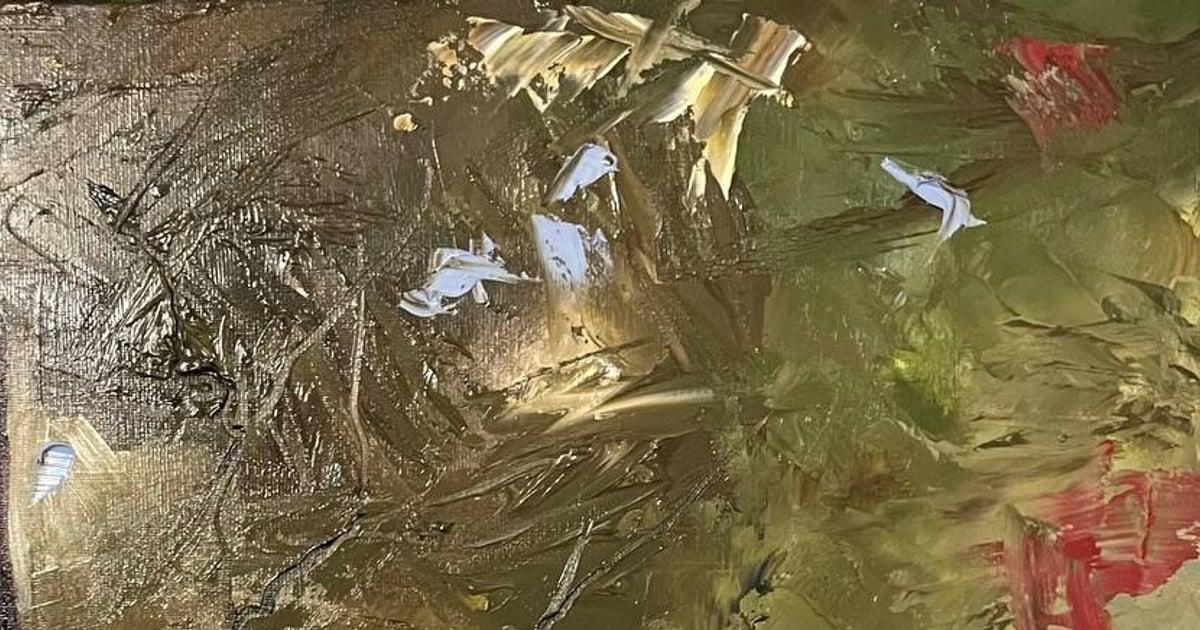
Table of contents
A canvas print looks convincing these days. Real woven texture, a wooden stretcher, rich colour — from three metres away not every painter could tell it from the real thing. Some sellers rely on exactly that: a €60 print goes up for sale as an "original artwork" at €600.
A print in itself is an honest product. The trouble starts when it's passed off as an original. Below is how to check a painting yourself in five minutes, with no expert and no special equipment.
Look at it from the side
The quickest test. Stand so that the light falls across the canvas almost parallel to the surface — from a window to one side, or from your phone's torch held close to the edge.
Oil paint sits in layers, and each brushstroke leaves relief. In raking light it casts tiny shadows: you can see which way the brush moved, where the paint lies thicker, where a palette knife cut an edge. The relief is often higher in the light passages, because white is laid on more heavily.
A print is flat in that light. Even if the canvas has texture, it's the texture of the weave — an even grid across the whole surface. It has no idea where the sky is and where the face is.
Check the edges
Turn the painting round and look at the sides of the stretcher.
On a painting, the paint runs onto the edge unevenly. The artist either continues the image round the sides or leaves them primed — and then you can see where the brush stopped. There are drips, fingerprints, stray marks.
On a print, the edges give the process away. The image is usually extended onto the side as a mirror reflection or a blur, or the side is a single flat colour. The line where the front turns onto the side is perfectly straight — no hand draws a line like that.
Use a magnifier
A magnifying glass will do, or your phone camera at full zoom. Point it at an even area — sky, background, shadow.
In a print, colour is built from dots. Offset printing produces a regular pattern of four-colour rosettes; inkjet produces a fine coloured grain, like noise in a photograph. Under magnification it's obvious at once.
A painting has no dots. The paint is physically mixed — on the palette or on the canvas itself — and under a lens you see streaks, brush hairs, fine cracks in the dried layer, specks of pure pigment that didn't fully blend.
Look at the back
The reverse tells you a great deal.
On an original, the artist often signs the back: name, title, year, sometimes size and medium. The canvas may be unevenly primed, with traces of glue and staples. Older works carry gallery and exhibition labels.
A printed canvas is uniform and pale on the back, often with the fabric maker's mark along the edge. A signature, if there is one, is in marker on bare fabric rather than part of the work.
The signature on the front
On an oil painting, the signature is painted in the same paint as the picture, on top of the dried layers. In raking light it has relief, like a brushstroke.
On a print, the signature was printed along with the image. It's flat, and it sits beneath the overall varnish rather than on top of it.
A special case — "hand-embellished"
The trickiest version. A print is taken and a few strokes of clear gel or paint are added over it — usually on highlights, wave crests, petals. Relief appears in raking light, and the first test seems to pass.
What gives it away is the mismatch. The relief is only in places, and beneath it are the same printed dots, if you look with a magnifier right beside a stroke. The strokes sit on top of the image rather than building it: in real painting, light and shadow are made of paint; here they are printed, with gloss added on top.
Honest sellers call this a "hand-embellished print". Dishonest ones call it an "original painting". The price difference between a true original and such an embellishment is many times over.
Paperwork and the story of the work
A certificate of authenticity guarantees nothing on its own — it comes out of the same printer. More reliable are:
- Process photos. An artist who paints the work themselves almost always photographs the stages: underpainting, intermediate layers, details. Ask for them. When I paint a commissioned portrait, the client receives progress photos along the way — it's normal practice.
- An invoice from the artist or gallery stating the medium.
- Contact with the artist. A living artist can simply be asked whether they painted it.
When a print is the right choice
A print isn't worse — it's something else. If you love a famous museum painting, want to fill a wall in a rented flat, or need office décor for a few years, a good print at a fair price beats a mediocre original.
An original makes sense when the work itself matters: one of a kind, with a surface that can't be repeated, painted by someone you know or can ask. With proper care an oil painting lasts for centuries — more on that in the article on caring for an oil painting. A good print fades within ten to twenty years.
If you're buying an original, it's worth understanding what you're paying for: layers built up over weeks — how layered oil painting works is covered separately.
FAQ — Frequently Asked Questions
Is a giclée an original?
No. A giclée is a high-quality inkjet print made with pigment inks. It lasts longer than an ordinary print and renders colour well, but it's still a print. Under a magnifier you see the grain; in raking light, a flat surface.
Can a print be varnished to look like oil?
Varnish adds gloss and a little protection, but it can't create brushstroke relief. Raking light and a magnifier will still reveal the print.
How do I check a painting I'm buying online?
Ask the seller for three photos: the painting in raking light, a close-up of the edge, and the back. An honest seller will send them without fuss. If they refuse, or send only front-on shots in flat light, that's a reason to be careful.
Does an oil painting smell?
A fresh one does — of linseed oil, for a few months after it's painted. A dried painting barely smells, so the absence of a smell proves nothing.
Are all the works in your gallery originals?
Yes. The painting gallery holds only works painted by hand in oil, each one unique. If you're interested in a particular piece, I can send photos of its edge and back.
Choosing a painting and want to be sure it's an original? Write to me — I'll send photos of any work from the painting gallery in raking light and from the back.